



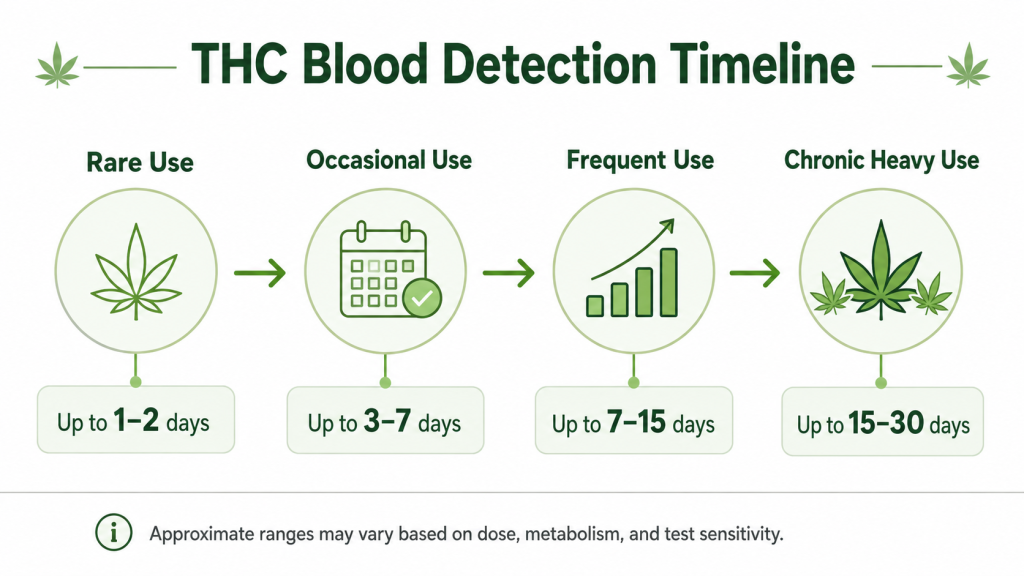
For someone who uses cannabis once or occasionally, active THC may be detectable in blood for several hours and sometimes around 12 to 24 hours. Frequent users may test positive for several days, while unusually long detection periods have been documented in some chronic, heavy users.
There is no exact timeline for everyone. Frequency of use, THC potency, dose, metabolism, consumption method, and laboratory sensitivity can all affect how long THC remains detectable.
Importantly, detectable THC does not necessarily mean someone is still high or impaired.
Key Takeaways
- •Blood testing generally reflects more recent cannabis exposure than urine or hair testing.
- •One-time use may be detectable for several hours and sometimes up to about 24 hours.
- •Frequent use can extend the detection window to several days.
- •THC may remain detectable after the noticeable high has ended.
- •Smoking, vaping, and edibles produce different blood-THC patterns.
- •No detox drink or home remedy can guarantee faster THC clearance.
How Long Can Weed Be Detected in Blood?
The detection window depends heavily on how often cannabis is used.
| Pattern of Use | Possible Blood Detection Window |
|---|---|
| One-time or rare use | Several hours; sometimes about 12–24 hours |
| Occasional use | Often within one day, but potentially longer |
| Frequent use | Approximately one to several days |
| Chronic, heavy daily use | Several days or longer; traces may persist much longer in unusual cases |
These are broad estimates, not guaranteed clearance times. A person cannot calculate an exact negative-test date from frequency alone.
Research involving chronic cannabis users has found cannabinoids in blood even after extended abstinence. One monitored-abstinence study reported detectable cannabinoids during a month of abstinence in some chronic daily users. NIH study on prolonged cannabinoid detection in chronic users
What Does a Cannabis Blood Test Detect?
The main intoxicating compound in cannabis is delta-9-tetrahydrocannabinol, commonly called THC. After THC enters the bloodstream, the liver begins converting it into other compounds.
A blood test may look for:
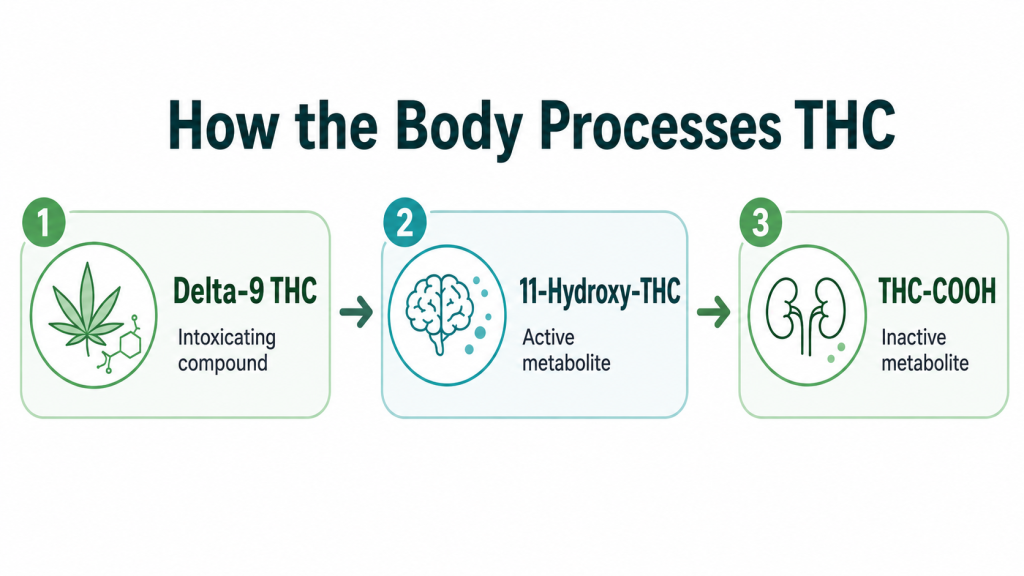
- Delta-9 THC: The main psychoactive compound associated with the cannabis “high.”
- 11-hydroxy-THC: An active metabolite produced as THC is processed, especially after edible consumption.
- THC-COOH: An inactive metabolite that can remain after the intoxicating effects have ended.
THC is metabolized into the active metabolite 11-hydroxy-THC and then into the inactive metabolite THC-COOH. The compound being measured changes how a result should be interpreted.
Active THC may indicate relatively recent exposure, but it cannot reveal the exact time cannabis was used. An inactive metabolite confirms prior exposure but does not prove current impairment.
The laboratory’s reporting cutoff also matters. A highly sensitive test can identify lower concentrations and create a longer detection window.
Factors That Affect How Long THC Stays in Blood
Several factors influence how long THC remains detectable in the blood. These factors vary from person to person, making it difficult to determine an exact detection period. The key factors affecting how long THC stays in the blood are mentioned below:
1. Frequency of Use
Frequency is one of the strongest factors.
THC is fat-soluble, meaning some of it can move from the bloodstream into fatty tissues. With repeated cannabis use, the body may store more THC, which can take longer to clear.
This is why daily consumers may have measurable THC after the immediate effects have ended.
Tolerance does not necessarily shorten this detection period. Someone who feels fewer effects because of regular use may still have measurable THC.
2. Dose and Potency
A higher dose introduces more THC into the body. Concentrates and high-potency products may create greater exposure than a small amount of lower-potency cannabis.
If cannabis quantities such as grams, eighths, quarters, and ounces are confusing, see GreenStone’s weed measurements guide.
3. Consumption Method
Smoking, vaping, and eating cannabis affect how quickly THC reaches the bloodstream and how its concentration changes.
4. Individual Biology
Age, genetics, liver function, metabolism, body composition, and overall health may influence how THC is processed.
None of these factors can independently predict an exact clearance time.
5. Test Sensitivity and Timing
Whole blood, serum, and plasma are not interchangeable testing materials, and laboratories may target different compounds.
A blood sample taken soon after use can also look very different from one collected several hours later.
6. Repeated Doses
Using cannabis several times in one session or on consecutive days makes a simple one-use estimate less reliable.
Does Smoking, Vaping, or Eating Edibles Make a Difference?
Yes. The way cannabis is consumed affects how THC enters the bloodstream.
Smoking or Vaping
When cannabis is inhaled, THC reaches the bloodstream within minutes. Concentrations rise quickly and then fall sharply as THC moves into tissues and is metabolized.
That makes blood testing useful for identifying relatively recent exposure, but a later blood sample cannot reliably show exactly when cannabis was consumed.
If you want to compare common vaping formats, see GreenStone’s guide to weed vape pens in California.
Edibles
Edibles are absorbed through the digestive system and processed by the liver. Their onset is slower than inhaled cannabis, and oral consumption produces more 11-hydroxy-THC through first-pass liver metabolism.
Dose, food intake, product formulation, and digestion can all affect the timeline.
In a controlled cannabis-brownie study, THC and 11-hydroxy-THC in whole blood generally peaked about 1.5 to 2 hours after consumption and usually returned toward baseline within eight hours, although metabolites could still be detected. Read the controlled cannabis brownie study on PubMed
Consumers can also compare different cannabis edible formats at GreenStone to see how doses and product types vary.
Does Detectable THC Mean You Are Still High?
Not necessarily.
Detection and impairment are related, but they are not the same thing.
Cannabis can affect:
- Coordination
- Reaction time
- Attention
- Memory
- Perception
- Decision-making
However, blood THC concentration does not correspond with impairment as consistently as blood alcohol concentration does.
The National Highway Traffic Safety Administration notes that, unlike alcohol, there is little evidence of a direct dose-response relationship between cannabis consumption, blood THC concentration, and driving impairment. NHTSA guidance on cannabis and driving impairment
A regular consumer may have residual THC without noticeable effects. Someone else may still be impaired while their blood THC concentration is already falling.
A single result therefore cannot reliably tell:
- Exactly how much cannabis was used
- Exactly when it was used
- How impaired the person is
Never use a blood-detection estimate or personal tolerance to decide whether driving is safe.
Also Read: GreenStone's How Long Does a Weed High Last? guide explains how the duration of the actual effects differs between smoking, vaping, edibles, and other formats.
How Do Blood Tests Compare With Other Cannabis Tests?
Different testing methods look for different evidence and have different detection periods.
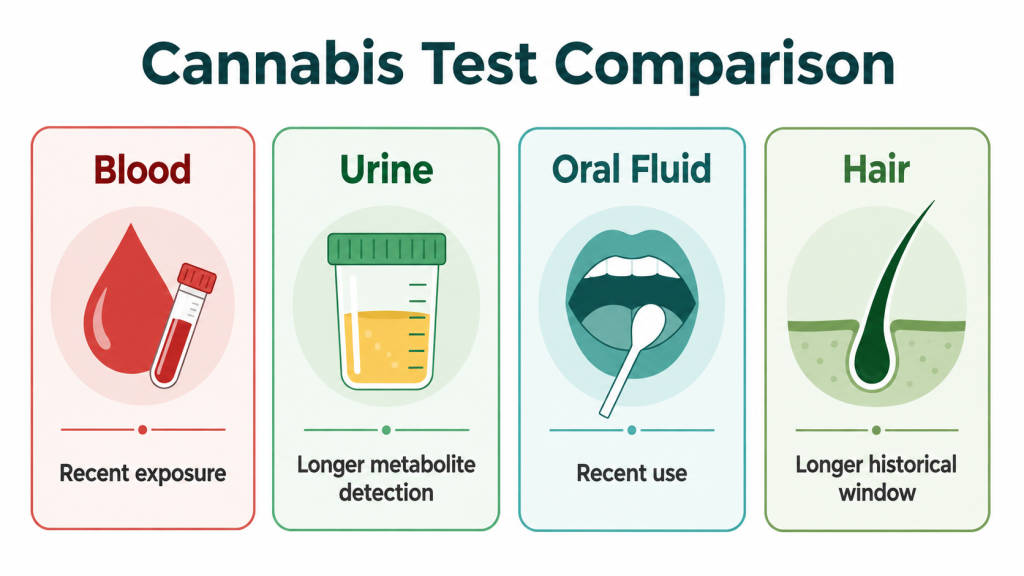
- Blood tests: Blood tests can measure active THC and are generally associated with recent exposure. They may be used in medical, accident-related, or forensic situations.
- Urine tests: Urine tests usually detect inactive THC-COOH. Because the body may continue excreting metabolites after active THC has fallen, urine generally has a longer detection window.
- Oral fluid tests: Oral fluid tests are commonly used to identify relatively recent exposure, although timing and consumption method can influence the result.
- Hair tests: Hair tests can provide a much longer historical window but cannot show whether someone is currently impaired or determine the exact time of consumption.
Federal workplace drug-testing programs currently authorize urine and oral fluid as specimen types. Blood is not the standard specimen under those federal guidelines, although private employers and other authorities may follow different policies.
Will Weed Show Up in Routine Blood Work?
Usually, no.
Cannabis does not automatically appear in standard blood work.
Tests such as a:
- Complete blood count
- Cholesterol test
- Liver panel
- Basic metabolic panel
measure specific health markers and normally do not include THC.
A separate cannabinoid, drug, or toxicology test generally needs to be ordered.
If you are unsure, ask the healthcare professional, laboratory, employer, or testing provider exactly which test was requested.
Can You Remove THC From Your Blood Faster?
There is no proven drink, supplement, detox kit, sauna routine, or home remedy that can guarantee rapid THC removal.
Time and continued abstinence are the main factors that reduce detectable THC concentrations.
Drinking excessive water does not simply wash THC out of the bloodstream and may create health risks.
Intense exercise is not a dependable shortcut either. Research involving regular cannabis users found that exercise could temporarily increase blood THC concentrations slightly as stored THC was released from body fat. NIH study on exercise and blood THC concentrations
Normal hydration, sleep, and nutrition support general health, but none can guarantee a negative test by a particular date.
The Bottom Line
How long weed stays in your blood depends mainly on how often cannabis is used, the amount and potency, the type of test, and the laboratory’s sensitivity.
After one-time or occasional use, active THC may be measurable for several hours and sometimes around 12 to 24 hours.
Frequent users may remain positive for one to several days, while unusually long detection periods have been documented in some chronic, heavy users.
These are estimates, not guaranteed clearance times.
And remember: a positive blood test can show cannabis exposure without proving that someone is still high or impaired.
If a result has medical, employment, driving, or legal consequences, rely on the testing provider or another qualified professional rather than a general online detection timeline.